

Therapy for OCD
When intrusive thoughts, doubt, and compulsions begin to take over, therapy can help you step out of the cycle.
Understanding OCD
OCD is more than unwanted thoughts or repetitive behaviours. It certainly is more than this idea that media passes of just being neat and tidy. It can leave you feeling trapped in cycles of doubt, checking, reassurance seeking, or mental reviewing. CBT helps you understand these patterns and develop new ways of responding to them.
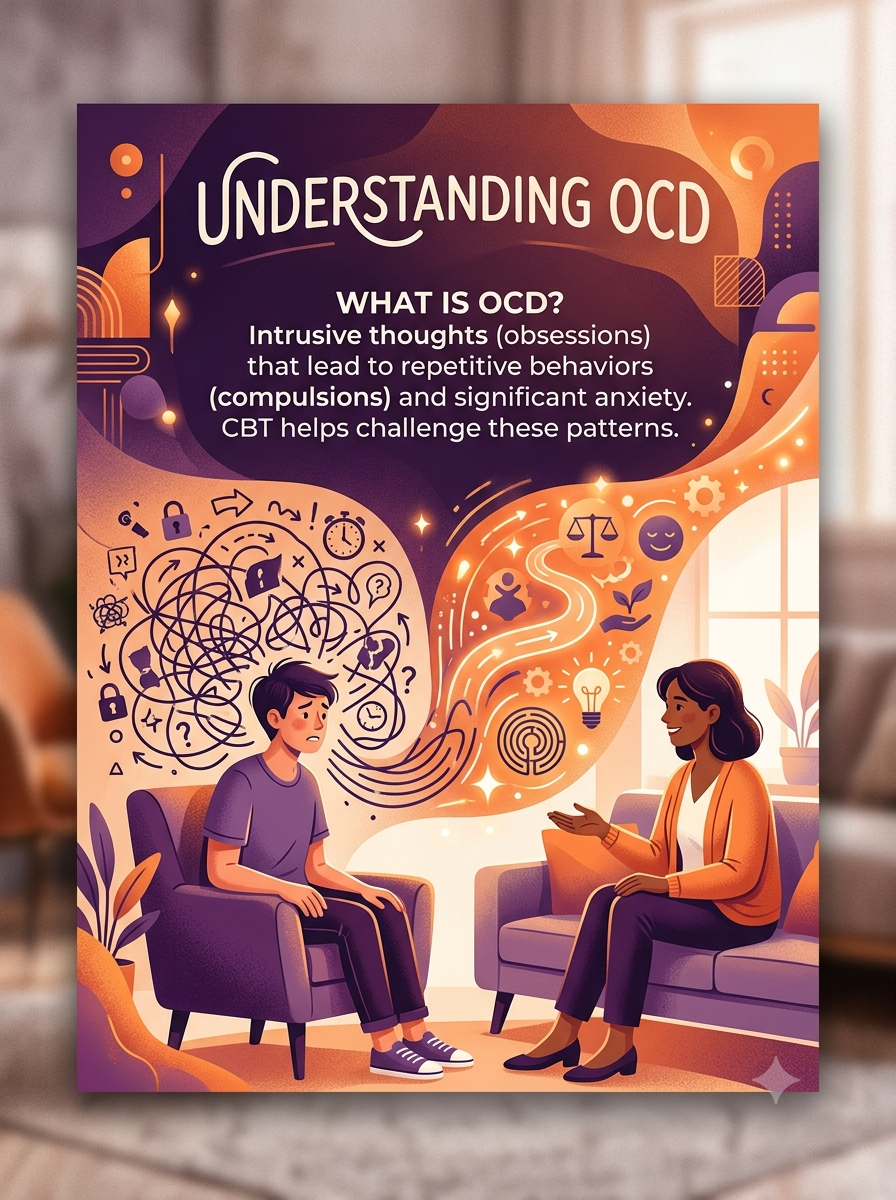
What OCD feels like
OCD can affect many areas of life. It often involves intrusive thoughts that are difficult to let go of. Both people with and without OCD experience intrusive thoughts. In OCD they are followed by a sense of doubt, a wanting to resolve something that can not really be resolved or a seeking for 100% certainty that can not be obtained.
In response, you might find yourself checking, seeking reassurance, avoiding situations, or repeatedly going over things in your mind. These strategies can bring some relief, but it is often short-lived, and the doubt soon returns.
Over time, OCD can become time-consuming and exhausting. It may affect your confidence, your relationships, or your ability to focus on the things that matter to you. You might end up spending more time thinking about all the possibilities and less and less time on your real life
Many people also find it difficult to talk about their experiences, particularly when the thoughts feel upsetting or out of keeping with their values. This can leave people feeling isolated, even though OCD is more common than many realise.

A common OCD sequence
OCD is often maintained by a repeating sequence of doubt and response:
Trigger (can be external or internal) → Doubt (what would happen if you’d let this come true) → Consequence of the doubt (what would happen if you’d let this come true) → Emotion (anxiety, distress, disgust, guilt) → Compulsion (can be external and observable, or something that happens in your mind only)
When the doubt feels important, the compulsion is used to try to reduce it. This can happen in a number of ways, including:
checking (externally or mentally)
seeking reassurance
replaying or analysing situations
trying to reach a sense of certainty before moving on
avoiding situations that bring up doubt
These responses may feel helpful in the moment, but they can also keep attention focused on the doubt itself and suddenly you are in a loop that feels impossible to get out of.
How OCD shows up
OCD can present in a number of different ways, and you might have noticed that it has shifted over time. It is very common that OCD triggers and doubts change and morph into others.
However, below the surface, it often follows a similar underlying pattern.
The obsessions - described as intrusive thoughts, urges, images or doubts, feel difficult to settle even when we might know they are not grounded in reality.
When the doubt turns inward
Sometimes in OCD the doubt shifts from a specific concern to how you are making sense of it, or what it might mean that you are trying to understand it.
What if I’m just trying to convince myself that I have OCD while actually I might be this horrible person.
From an OCD perspective, this is part of the same process: doubt generating further doubt, with increasing pressure to find certainty about what it all means.
In therapy, the focus is not on answering each doubt, but on understanding and changing the process that keeps them going.
Therapy for OCD
Therapy focuses on understanding how OCD is being maintained, rather than spending a lot of time engaging with the content of individual doubts. That is already happening for you. Therapy needs to be different.
We begin by making sense of your individual pattern — how doubt arises, how it is responded to, and what keeps the cycle going over time. This will allow you and I to decide between the two different modalities I work with.
CBT & ERP
This approach focuses on understanding the meaning of the intrusions and how the OCD cycle is maintained through compulsions such as checking, reassurance seeking, avoidance, and mental reviewing.
We work on:
identifying compulsive responses
gradually reducing these patterns
learning to tolerate uncertainty without needing to resolve it
testing out feared predictions in a structured way
The aim is to reduce the hold that OCD has on day-to-day decisions and behaviour.
Inference-based CBT
This approach focuses more on how doubts are formed (through inferential confusion) and how attention shifts towards imagined possibilities rather than what is directly known or experienced.
We work on:
recognising when thinking shifts into “what if” narratives
strengthening trust in what is known in the moment
reducing engagement with inferential doubt processes
stepping out of the reasoning pattern that maintains OCD
The aim is to reduce the credibility of OCD doubt itself, rather than getting drawn into resolving it.
Getting started
You do not need to be certain about a diagnosis before getting in touch.
Many people come to therapy because they recognise aspects of OCD in their experience and want to understand it more clearly.
If it feels helpful, the next step is usually an initial consultation, where we can look at what is happening for you and whether this approach feels appropriate.
From there, we decide together how to proceed.